
What Google Ads really cost a contractor.
The honest answer is not a number, it is a way to think about it. There are two separate costs, a handful of things that drive what you pay, and one question that matters more than price: what comes back. Here is how to budget for ads from what a booked job is worth to you, instead of guessing at a figure and hoping.
Ad spend and management are not the same thing.
Most of the confusion about what Google Ads cost comes from squashing two very different things into one number. The first is ad spend: the money that goes straight to Google for the clicks or leads themselves. That lives in your own account, you control it, and you can turn it up or down anytime. The second is management: what you pay a person to build the campaigns, point them at the right searches, and tune them against real results week after week. I keep those two fully separate, so there is never a percentage-of-spend markup buried in the middle quietly rewarding whoever runs your account for spending more of your money. You see the spend, you see the management, and you always know which is which. That separation is the whole reason ads stay honest, because the moment they are blended you cannot tell whether a bigger bill bought you more jobs or just a bigger cut for the agency. The Google Ads work itself and the money behind it stay side by side, in the open.
What decides your cost per click and cost per lead.
There is no flat rate for a click in the trades, because the price is set by your situation. A few specific things move it up or down, and knowing which ones you can control is half the battle.
What you sell
An urgent, high-ticket service gets bid up harder than a routine one, because everyone wants those searches. The value of the job is baked into what a click costs.
How crowded the market is
The more contractors bidding on the same local searches, the higher the price to sit at the top. A dense metro costs more per click than a quiet corner of it.
How tight the campaign is
Loose targeting pays for clicks that were never going to call, from the next county over or people who wanted to do it themselves. Tight targeting keeps the money on real buyers.
How relevant Google finds you
Google charges less for the same spot when your ad and landing page are relevant and fast. A better page literally lowers your price, which is why the site comes first.
When your ads run
Paying for clicks at hours nobody answers wastes them. Running ads when you can actually respond, backed by follow-up, drops your true cost per booked job.
What the click lands on
The click is only half the cost. If the page does not turn visitors into calls, you pay for traffic and get nothing, which quietly makes every lead cost far more.
Cost thinking keeps you stuck. Return thinking sets the budget.
Asking what it costs
- Starts from a number picked out of the air, not from the work it has to pay for
- Treats cheap clicks as a win, even when they book nothing
- Judges ads by the monthly bill instead of the jobs on the calendar
- Cuts spend the moment it feels expensive, right when it is working
Asking what comes back
- Starts from what a booked job is worth and works the budget backward from there
- Measures the true cost per booked job, not the price of a click
- Judges ads by jobs closed, proven with call tracking, in plain numbers
- Scales what pays off and cuts only what does not, on evidence
Budget from what a booked job is worth.
The right budget is not a figure you copy off another contractor, it is one you build from your own math. Start with what a closed job is worth to you, then work backward. If you know roughly how many leads it takes to land a job and how many clicks it takes to get a lead, you can set a budget that has a real chance of paying for itself and still leaving profit on top. That is the whole point: the spend should be sized to the jobs you want to book, not to a round number that felt safe. So I scope it to your trade, your market, and your goals on a call rather than quoting a flat figure, and I start conservative and scale what actually books work instead of betting big on day one. And before a dollar goes to Google, the foundation has to be right, because sending paid clicks to a slow site with no fast follow-up is the fastest way to make ads look expensive when the real problem was the website. Get the management and the page right, and the budget starts working instead of leaking.
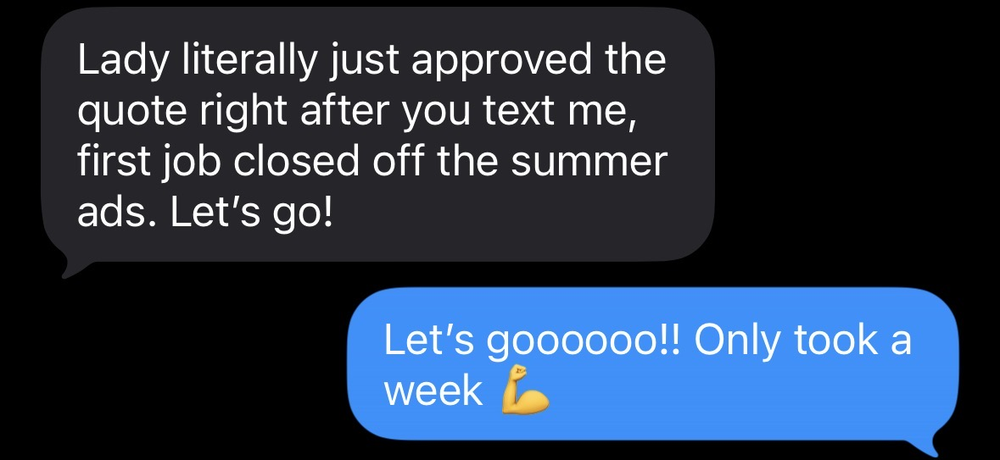
First job closed off the ads, in about a week.
Measured in booked jobs, not vanity metrics.
No mystery reports. The whole point is the line going up and to the right, more calls and booked jobs every month as the work compounds.
4.8 stars across 17 Google reviews.
Working with Zack was one of the best things I could have done for my business. His creative content has significantly increased my leads, and the conversations and brainstorm sessions have been just as instrumental in my business's growth. Can't recommend enough.
Zachary did a phenomenal job on my website. My goal was to gain added SEO, which he achieved, and as a result more organic traffic came to my real estate website. Thank you for the quickness on delivery, he completed it in about a week.
Zack helped me build not only a website but a tool. This helps me stay organized on a daily basis... I couldn't have envisioned what I wanted more accurately than what he was able to deliver. I would recommend Zack for your project in a heartbeat.
I had an amazing experience working with Zack on my website and marketing. From start to finish, everything was handled.
Straight answers.
What do Google Ads actually cost a contractor?
There are two separate costs, and the confusion comes from mixing them. The first is ad spend, the money that goes straight to Google for the clicks or leads, in your own account, and you control it. The second is management, what you pay someone to build, run, and tune the campaigns. I keep them fully separate, so there is no percentage-of-spend markup hidden in the middle and you can always see where every dollar went.
What drives the cost per click and cost per lead in the trades?
Four things mostly. Your trade, because an urgent, high-ticket service is bid up harder. How competitive your area is, because more contractors bidding pushes the price up. How tightly the campaign is targeted, because loose targeting pays for clicks that never call. And your quality score, Google's read of how relevant your ad and page are, because a better, faster page lowers what you pay for the same spot. The first two you cannot change. The last two are the job.
How should a contractor set a Google Ads budget?
Work backward from what a booked job is worth, not from a number you picked out of the air. If you know roughly what a closed job brings in and how many leads it takes to close one, you can set a budget with a real chance of paying for itself and still leaving profit. I scope it to your trade, market, and goals on a call rather than quoting a flat figure, and I start conservative and scale what actually books work.
Is the real question how much Google Ads cost?
Not really. Cost only matters next to what comes back. Cheap ads that book nothing are expensive, and ads that cost more but fill your calendar are the bargain. For most trades a single closed job covers a large chunk of a month of ads, so the question that matters is return: how many jobs did the spend book. That is exactly what call tracking is there to prove, in plain numbers, instead of a guess.
Related pages
Built from the foundation up, so every dollar compounds.
Everything I run uses The Cornerstone System: a converting site and a lead-response loop first, then SEO, content, and ads layered on in the order that compounds. No contracts, you own everything from day one, and one honest person you can hold accountable runs all of it. See how the Cornerstone System works →
Want to know what ads would take in your market?
Start with a free audit. I will walk you through the two costs, what would drive your price in your trade and area, and a budget scoped to what a booked job is worth to you, on a 20-minute call. Every plan is scoped to your market, no cookie-cutter packages.
Not ready for a call? Get a free instant website audit. Powered by HopHQ, my free SEO tool.
Serving the Lehigh Valley and beyond. You own everything I build. (610) 936-8112